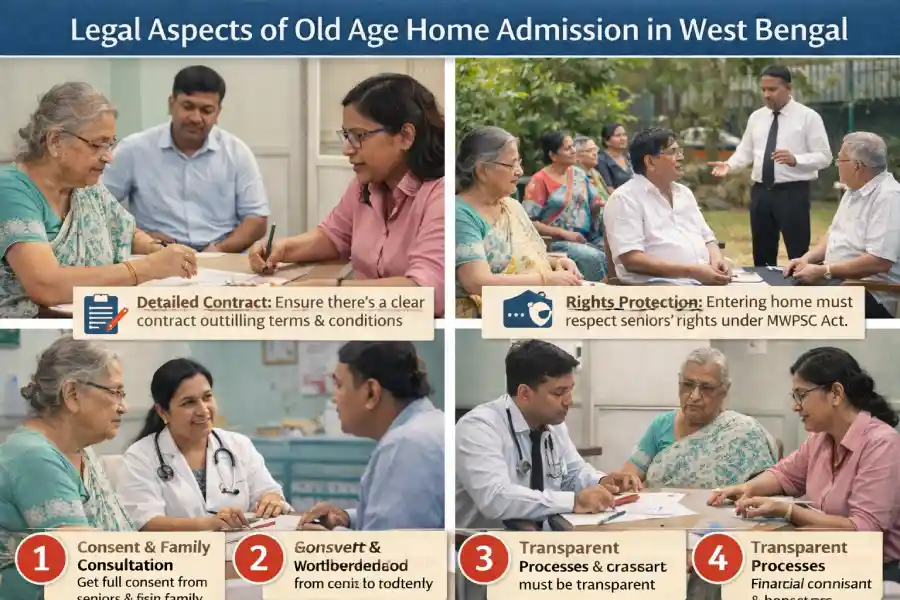
Legal Aspects of Old Age Home Admission in West Bengal – 2026 Family Guide
Published: May 2026 | Reading time: 10 minutes
Admitting an elderly family member to an old age home is not just an emotional decision – it is a legal contract. Yet most families in West Bengal sign documents without reading them, unaware of their rights or the home’s obligations. This can lead to deposit disputes, sudden eviction, hidden fees, or even neglect.
This guide covers the key legal aspects every family must know before signing any admission agreement in West Bengal. By 2026, new state guidelines and consumer court rulings have strengthened senior citizens’ rights – but only if you are informed.
If your loved one has dementia or memory loss requiring specialised medical and behavioural care, legal paperwork alone is not enough. Please see our resource on Old Age Home for Dementia Care in Kolkata for information on memory‑specific facilities. This guide focuses on general legal requirements for old age home admission in West Bengal.
1. Is There a Specific Law for Old Age Homes in West Bengal?
West Bengal does not yet have a standalone “Old Age Home Registration Act”. However, several laws and policies apply:
| Law / Policy | What It Covers |
|---|---|
| West Bengal Nursing Homes Act, 1950 (amended) | Applies if the home provides any medical/nursing services. Registration with the Chief Medical Officer of Health (CMOH) is required. |
| West Bengal Societies Registration Act, 1961 | Many homes run by trusts or NGOs register under this. Not mandatory for all, but gives some accountability. |
| Maintenance and Welfare of Parents and Senior Citizens Act, 2007 (Central Act) | Gives seniors the right to sue children/relatives for maintenance. Also allows state to register old age homes, but West Bengal’s implementation is weak. |
| West Bengal Senior Citizens Policy, 2021 (draft/partially implemented) | Recommends minimum standards, grievance redressal, and mandatory registration – but not fully enforced yet. |
| Consumer Protection Act, 2019 | Most important for families. Old age home services are considered “service” – you can file a complaint in consumer court for deficiency. |
👉 Takeaway: No single law fully regulates old age homes in West Bengal, but multiple legal tools exist to protect residents. Always choose a home that can show at least a trade license and (if they claim medical facilities) a nursing home registration.
2. Mandatory Documents You Must Collect Before Admission
Never sign an admission form without receiving your own copy of these documents:
For the senior resident:
- Medical certificate from a registered doctor (within 15 days of admission) – stating physical and mental condition, including any diagnosis (dementia, heart disease, etc.).
- Age proof (Aadhaar, Voter ID, Passport, or Birth certificate).
- Identity proof (same as above).
- Photographs (passport size, 4‑6 copies).
- Vaccination records (COVID‑19, flu, etc.) – newer requirement in many homes.
- Advance medical directive (Living Will) – if available, though not common in West Bengal yet.
For the family/guardian:
- Guardian’s ID proof (Aadhaar, Voter ID).
- Proof of relationship (ration card, birth certificate, or a notarised affidavit).
- Emergency contact details (2‑3 persons).
- Financial guarantee letter (if someone else is paying).
Documents the home must provide to you:
- Copy of admission agreement (signed by both parties).
- Fee structure (itemised: deposit, monthly rent, medical charges, extra charges).
- Rules and regulations (visiting hours, leave policy, notice period).
- Licenses (trade license, nursing home registration if applicable).
- Emergency protocol (written).
Warning: If the home says “we will give you the agreement after you pay the deposit” – walk away.
3. Critical Clauses to Check in the Admission Agreement
Most families skip reading the fine print. Don’t. Pay special attention to:
a) Deposit refund clause
Is the deposit fully refundable? Under what conditions? Timeframe for refund after vacating (should be ≤90 days, ideally 30‑45 days). Deductions allowed (e.g., damages to room – ask for a checklist on admission).
b) Monthly fee & hidden charges
What is included? (Room, food, basic utilities, laundry, nursing?) Extra charges list (AC electricity, special diet, escort to doctor, diapers). Annual increase (typically 5‑10% – must be mentioned, not “at management’s discretion”).
c) Medical responsibilities
Does the home provide medication administration? (Many say “we remind” but not “we give” – difference matters legally.) What happens in an emergency? (Ambulance, nearest hospital – name must be written.) Can the home refuse to admit a resident with certain conditions? (e.g., infectious diseases, severe dementia – they must state this upfront.)
d) Notice period and eviction
Notice required from resident/family to vacate (typically 30‑60 days). Notice required from home to evict a resident (must be reasonable, e.g., 30 days, except for violence or non‑payment). Grounds for immediate eviction – should be limited (assault, property damage, non‑payment beyond 2 months).
e) Grievance redressal
Internal complaint process (whom to contact). Arbitration clause? (If they force arbitration outside courts, it may disadvantage you.)
f) Death and disposal of body
What happens if a resident dies? (Home must inform family, not dispose of body without permission.) Who bears funeral expenses? (Usually family.)
Sample red flag phrase: “Management reserves the right to change rules and fees at any time without notice” – this is unfair and may be challenged in consumer court.
4. Rights of Senior Citizens Living in Old Age Homes (West Bengal Context)
Under the Maintenance and Welfare of Parents and Senior Citizens Act, 2007 and consumer law, residents have:
| Right | Explanation |
|---|---|
| Right to dignity | No physical or verbal abuse. Neglect (bedsores, dehydration) is actionable. |
| Right to information | Full disclosure of fees, rules, and medical status. |
| Right to privacy | Rooms cannot be searched arbitrarily; personal belongings cannot be confiscated. |
| Right to refuse treatment | Resident can refuse medication or procedures (unless declared mentally unfit by a doctor). |
| Right to visitors | Within reasonable hours (cannot be zero visitation). |
| Right to leave | Resident can leave after giving notice – home cannot detain them over fee disputes (they can file a recovery suit, not physically confine). |
| Right to complain | To the district Senior Citizens Protection Officer, local police, or consumer court. |
If any of these are violated, you have legal recourse.
5. How to File a Complaint Against an Old Age Home in West Bengal
If you face deposit non‑refund, neglect, overcharging, or abuse:
Step 1 – Internal grievance
Write a formal letter to the home’s management (keep a copy with acknowledgement).
Step 2 – District Senior Citizens Protection Officer
Under the 2007 Act, every district has a Protection Officer (usually under the District Social Welfare Officer). File a complaint in writing. They can mediate and even recommend action.
Step 3 – Consumer Court (most effective for monetary disputes)
Old age home services are a “service” under the Consumer Protection Act. For claim up to ₹50 lakh: file in District Consumer Disputes Redressal Forum (in Kolkata – at Bikash Bhavan, Salt Lake). No lawyer is required, but you can hire one. The process is faster than civil court.
Step 4 – Police complaint
For physical abuse, illegal confinement, or criminal negligence (e.g., death due to lack of emergency care), file an FIR at the local police station under Bharatiya Nyaya Sanhita (BNS) sections on hurt, criminal negligence, or wrongful confinement.
Step 5 – Media & senior citizen helplines
West Bengal Senior Citizens Helpline: 1800 212 1965 (toll‑free, but often busy). National Helpline for Senior Citizens: 14567. Local newspapers (Kolkata editions) often take up genuine cases.
6. Common Legal Disputes and How to Avoid Them
| Dispute | How families get trapped | Prevention |
|---|---|---|
| Deposit not refunded | No written agreement, or home cites “voluntary donation” | Get a receipt stating “refundable deposit”, not donation. |
| Sudden fee hike | Agreement allows “management discretion” | Insist on fixed annual increase percentage in writing. |
| Eviction without notice | Resident becomes ill or disruptive | Agreement must specify medical grounds for eviction and notice period. |
| Hidden medical charges | “Nursing care included” – but special services (IV, injections) charged extra | List all chargeable medical acts. |
| Family not informed of death/hospitalisation | No clause in agreement | Write explicitly: “Home must inform emergency contact within 1 hour of any serious event.” |
7. Special Legal Note for Dementia Patients
If your loved one has diagnosed dementia, the legal capacity to sign agreements comes into question. A person with moderate‑to‑severe dementia cannot legally sign a binding contract.
- The family member (guardian) must sign on their behalf.
- If no legal guardian exists, obtain a guardianship certificate from the District Magistrate under the Mental Healthcare Act, 2017 (though rarely done in practice for old age home admission).
- Most homes accept a family member as the signatory with a simple declaration of relationship.
For specialised legal and medical support for dementia patients, consult our dedicated page: Old Age Home for Dementia Care in Kolkata. Standard old age homes may not have the legal or medical capacity to handle advanced dementia.
8. Recent Legal Developments in West Bengal (2024‑2026)
- Draft West Bengal Senior Care Homes (Registration and Regulation) Rules, 2025 – Proposed. If passed, all homes with 10+ residents must register with the state, maintain minimum staff ratios, and submit annual audits. Not yet law, but a positive sign.
- Consumer court rulings – In 2024, the South 24 Parganas District Consumer Forum ordered an old age home in Behala to refund ₹85,000 deposit with 12% interest for unfair deduction. Precedents help families.
- Kolkata Police senior cell – Now has a dedicated unit for elder abuse complaints, including those in institutions.
Frequently Asked Questions (FAQ) – Legal Aspects
No universal license exists, but homes providing medical care must register under the West Bengal Nursing Homes Act. Others need at least a trade license from the local municipality. Avoid unlicensed homes.
No. The agreement must specify notice period (minimum 30 days). Immediate eviction only for violence or non‑payment beyond 2 months. Without notice, it is illegal eviction – file a police complaint.
Send a legal notice (through a lawyer or via registered post). If no response, file a consumer complaint. Most homes settle before court hearing.
Yes, if they claim to provide nursing/medical care and a resident is harmed due to lack of timely help (e.g., not calling ambulance for heart attack). Proving negligence requires evidence (logs, CCTV, witness statements).
No legal right to force entry outside designated hours. However, if the home never allows any visitation, you can complain to the Senior Citizens Protection Officer.
For routine care (BP medication), consent is implied in the admission agreement. For major procedures (surgery, ICU transfer), they should inform you. For a resident with dementia, you as guardian must consent.
The home must secure belongings and hand them over to the legal heir within a reasonable time (7‑14 days). If they withhold items, you can file a police complaint for criminal misappropriation.
Final Advice for Families in West Bengal
- Never pay cash – Always take a bank transfer or cheque receipt. Insist on a signed receipt for every payment.
- Keep copies – Of the agreement, fee structure, and every payment proof.
- Visit unannounced – Legal rights are meaningless if you don’t monitor actual conditions.
- Talk to other families – Ask if they ever had deposit issues or unaddressed complaints.
- Consult a lawyer – For complex cases (large deposits, forced eviction, injury), a local lawyer familiar with West Bengal senior laws can help.
Being legally informed does not make you a difficult family – it makes you a careful one. A reputable old age home will welcome transparency.
If your loved one requires specialised dementia care with 24/7 medical supervision, standard legal paperwork may not address their safety needs. See our dedicated facility: Old Age Home for Dementia Care in Kolkata.
⚖️ Need Legal Help or a Trusted Old Age Home in Kolkata?
We combine compassionate care with transparent legal agreements. Compare our facility’s terms and family reviews.
Explore Old Age Home Directory →