
When Seniors Resist Assisted Living: A Compassionate Guide for Families
Watching a parent or loved one struggle with daily tasks while adamantly refusing help is one of the most heart-wrenching experiences a family can face. When seniors resist assisted living, it often stems from a deep-seated fear of losing independence, privacy, and their sense of self.
As we move through 2026, the approach to senior care has shifted from “placement” to “partnership.” This guide provides an empathetic, expert-backed framework to help your family navigate these turbulent waters with dignity and respect.
Integrating Local Expertise: Old Age Home in Kolkata
For families living in or moving back to West Bengal, finding the right environment is key. If you are looking for a facility that balances traditional values with modern medical amenities, exploring a reputable old age home in Kolkata can provide the cultural comfort and community support your loved one needs. Many premium homes in Kolkata now offer specialized geriatric care that respects the independence of the resident while ensuring 24/7 safety.
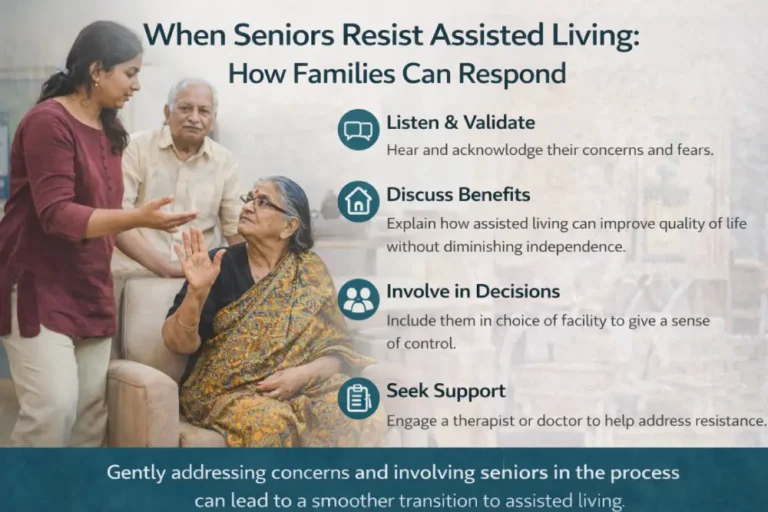
Understanding the Root of Resistance
Before jumping into solutions, it is crucial to understand why seniors resist assisted living. It is rarely about the quality of the facility; it is about what the move represents.
Fear of the Unknown: For someone who has lived in the same home for 40 years, the idea of a “facility” feels like an institution rather than a community.
Loss of Autonomy: The transition feels like a surrender of adulthood.
Grief: Moving often requires downsizing, which means letting go of a lifetime of memories and physical belongings.
Cognitive Decline: Conditions like dementia or Alzheimer’s can impair a senior’s ability to recognize their own limitations (anosognosia).
7 Strategies to Respond When Seniors Resist Assisted Living
1. Start the Conversation Early (The “Drip” Method)
Don’t wait for a medical crisis or a fall to bring up the topic. When families rush the decision during an emergency, the senior feels “trapped.” Instead, use the “drip method”—mentioning observations casually over months. “I noticed the stairs are getting harder for you; have you thought about what kind of place would make life easier?”
2. Listen More Than You Talk
Validation is your strongest tool. If they say, “I’m never leaving this house,” don’t argue with logic. Instead, try: “I hear how much you love this home and the memories here. I want to make sure you’re always in a place where you feel that happy and safe.” When seniors resist assisted living, they need to feel that their voice still carries weight.
3. Focus on “Social Connection” Over “Care”
The term “Assisted Living” sounds clinical. Focus on the lifestyle benefits:
Chef-prepared meals (no more cooking/dishes).
Built-in social clubs and hobby groups.
Transportation to shopping and events.
Freedom from home maintenance (lawn care, repairs).
4. Visit Without the “Move-In” Pressure
Take your loved one to a community for a “trial” experience. Many modern communities offer lunch tours or even short-term respite stays. Letting them see the vibrant atmosphere can demystify the “nursing home” stigma.
5. Involve a Third-Party Expert
Sometimes, a child’s advice feels like “parenting the parent.” A doctor, a geriatric care manager, or a trusted spiritual leader can often deliver the same message with more authority and less emotional baggage.
6. Give Them the Power of Choice
Resistance often comes from feeling powerless. If a move is non-negotiable for safety reasons, give them control over the details:
“Which of these three communities do you like best?”
“Which furniture pieces do you want to bring to your new suite?”
7. Highlight the Burden on the Caregiver (Use with Caution)
If you are the primary caregiver and are experiencing burnout, it is okay to be honest—gently. “Mom, I love taking care of you, but I’m worried I can’t provide the medical safety you deserve while also managing my own health/work.”
The Role of Safety and Quality of Life
When seniors resist assisted living, families often feel guilty. However, it is important to weigh “emotional comfort” against “physical safety.” Chronic isolation, medication errors, and fall risks are significant dangers that assisted living effectively mitigates.
In 2026, many communities now offer Aging in Place models where the level of care scales with the resident, meaning they won’t have to move again if their needs increase.
Conclusion
The journey is rarely a straight line. When seniors resist assisted living, it requires patience, multiple conversations, and a whole lot of love. By shifting the narrative from “giving up” to “gaining support,” you can help your loved one transition into a chapter of life that is safer, more social, and less stressful for the entire family.
FAQ: Navigating Senior Care Resistance
1. What do I do if my parent is unsafe but refuses to move? If there is an immediate danger (like cognitive impairment or frequent falls), consult with a geriatrician. In extreme cases, a “capacity assessment” may be necessary to determine if they can legally make their own housing decisions.
2. How do I handle the guilt of moving a parent? Remember that your role is to be the “daughter” or “son,” not the “medical nurse.” By moving them to a professional setting, you can return to focusing on your relationship rather than just caregiving tasks.
3. Is assisted living the same as a nursing home? No. Assisted living is designed for seniors who need help with “Activities of Daily Living” (ADLs) but want to maintain an active, social lifestyle. Nursing homes provide higher-level clinical and medical supervision.
4. How much does assisted living cost in 2026? Costs vary by location and care level. It is best to consult with a financial advisor specializing in eldercare to explore long-term care insurance, veterans’ benefits, or home equity options.
5. How long does the “adjustment period” usually last? Most seniors take 3 to 6 months to fully settle into their new environment. Consistent visits and encouraging them to join one social activity per week can speed up this process.

M.A.(Hons) in Geography at University of Calcutta.
writing-specific social work courses such as interviewing and documentation,
professional seminars, and writing modules in all BSW and MSW