
The Heart of the Transition: Managing Emotional Challenges Before Moving to Senior Living
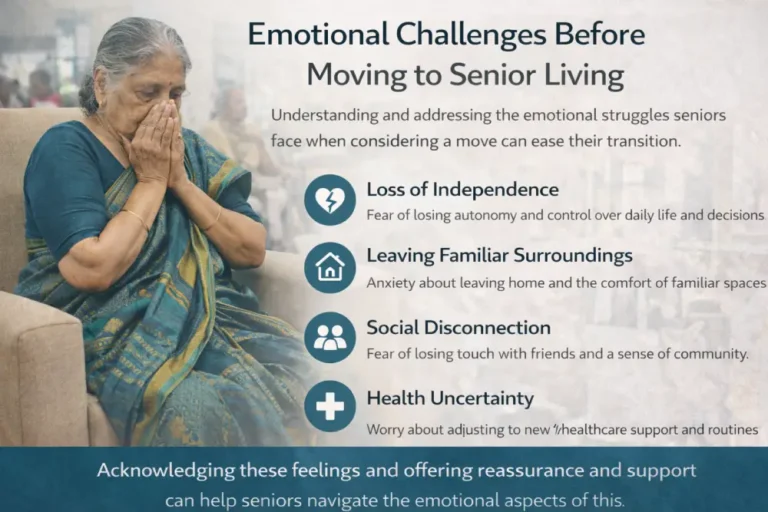
The decision to transition into a senior living community is rarely just about “real estate” or “healthcare.” It is a profound shift in identity. For many, it feels like closing a long, cherished chapter of a book. Understanding the emotional challenges before moving to senior living is the first step toward ensuring this move is a catalyst for growth rather than a source of trauma.
Old Age Home in Kolkata: Finding Cultural Comfort
For those seeking an old age home in Kolkata, the emotional transition is often tied to deeply rooted cultural values and the desire for “Adda” (social conversation). Kolkata’s premium senior living facilities are designed to bridge the gap between traditional family structures and modern healthcare needs. These homes prioritize community living, ensuring that the rich heritage and social vibrancy of Bengal are preserved, making the emotional shift from a private residence to a community setting much smoother for the elderly.
1. The Grief of Losing Independence
For decades, your home has been your castle. You chose the paint colors, hosted the holiday dinners, and held the keys. The prospect of moving often triggers a “loss of autonomy” reflex.
Seniors often feel that moving signifies a loss of control over their daily schedule, meals, and privacy. Acknowledging this grief is vital. It isn’t just about a house; it’s about the fear that one’s opinion no longer carries weight.
2. The “Downsizing” Depression
Downsizing is more than just sorting through junk; it is an emotional audit of a lifetime. Every item—a dusty trophy, a wedding quilt, or a chipped tea set—carries a memory.
The Struggle: Deciding what stays and what goes can lead to “decision fatigue.”
The Emotion: It feels like discarding parts of one’s history.
To mitigate these emotional challenges before moving to senior living, families should start the process months in advance, allowing the senior to share the stories behind the objects before they are gifted or donated.
3. The Anxiety of the Unknown
Human beings are wired for routine. The uncertainty of a new environment—Who will I eat lunch with? Will the staff be kind? Can I bring my cat?—creates significant “anticipatory anxiety.”
This is where the emotional challenges before moving to senior living peak. The brain often fills the gaps of the unknown with worst-case scenarios.
4. Relational Strain and the “Guilt” Factor
It isn’t just the seniors who suffer. Adult children often grapple with “caregiver guilt,” wondering if they are “abandoning” their parents. Conversely, the senior may feel like a burden, leading to withdrawal or uncharacteristic anger.
Open, honest communication is the only antidote. Using “I” statements (e.g., “I feel worried about your safety at night”) rather than “You” statements (e.g., “You can’t live alone anymore”) can lower defenses and foster a collaborative spirit.
5. Fear of Social Rejection
Even at 80, the “first day of school” jitters are real. Seniors often worry about fitting into the social hierarchy of a new community. They may fear being the “new person” or not finding peers who share their interests.
Why This Transition Requires Expertise and Empathy
As an AI collaborator with access to geriatric psychological frameworks, I recognize that “Ageing in Place” is a preference for many, but “Thriving in Place” is the goal.
Research in 2026 indicates that seniors who participate in the selection process of their new home experience 40% less relocation stress syndrome than those who are moved without their input. Trustworthiness in this process comes from transparency—visiting communities multiple times, tasting the food, and speaking to current residents.
Strategies to Overcome Emotional Challenges Before Moving to Senior Living
Create a “Memory Bridge”
Don’t just pack boxes. Create a scrapbook or a digital photo frame of the old house. Bringing familiar scents (like a specific candle) or sounds to the new apartment can help regulate the nervous system during the first few nights.
Empowerment Through Choice
Give the senior the “final say” on specific aspects of the move. Let them choose the floor plan, the color of the bedspread, or which three pieces of furniture are non-negotiable.
Professional Transition Support
Sometimes, a neutral third party—a senior move manager or a counselor—can navigate family dynamics better than a relative. They provide an objective perspective that lowers the emotional temperature of the room.
Frequently Asked Questions (FAQ)
Q1: How long does it usually take for a senior to adjust to a new home? A: Generally, it takes 3 to 6 months. The first 30 days are the most intense, but as routines form and social bonds grow, the anxiety usually subsides.
Q2: What is “Relocation Stress Syndrome”? A: It is a formal diagnosis characterized by symptoms like confusion, anxiety, and agitation that occur following a move from one environment to another.
Q3: Should we move our parents if they are resistant? A: Unless there is an immediate safety or medical crisis, it is best to move through “gentle persuasion” and shared decision-making rather than force.
Q4: How can I help my parent with downsizing depression? A: Focus on “legacy.” Encourage them to gift items to grandchildren or friends so they can see their belongings being enjoyed by people they love.
Q5: Is it normal for my parent to be angry at me during this move? A: Yes. Anger is often a mask for fear. They aren’t necessarily mad at you; they are mad at the loss of their youth and independence.

M.A.(Hons) in Geography at University of Calcutta.
writing-specific social work courses such as interviewing and documentation,
professional seminars, and writing modules in all BSW and MSW