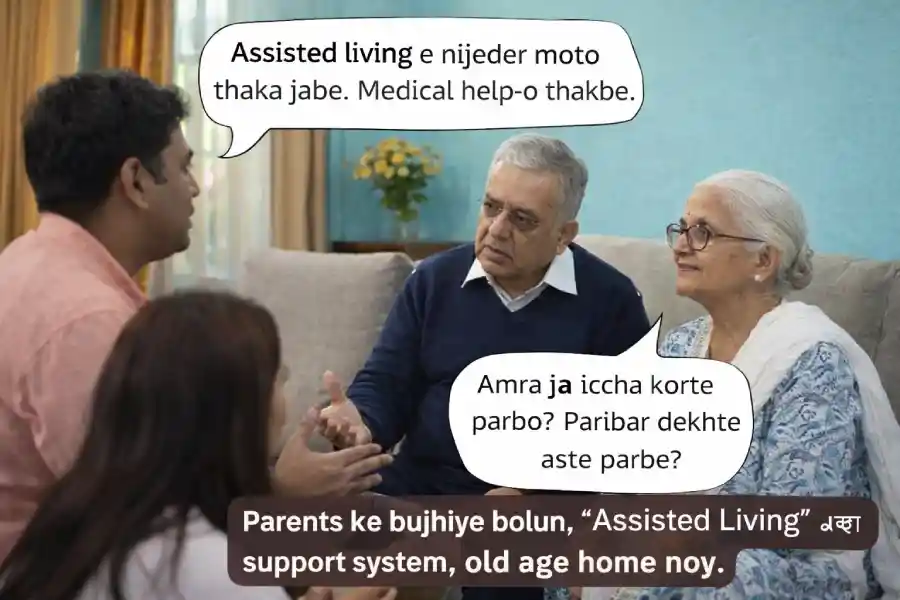
Talking to Parents About Assisted Living – 2026 Family Communication Guide
Published: May 2026 | Reading time: 7 minutes
Initiating a conversation about assisted living with an aging parent is one of the most delicate challenges a family can face. Even when the need is clear—safety concerns, declining health, caregiver exhaustion—the discussion can trigger guilt, fear, and resistance. Yet avoiding the conversation often leads to crisis: a fall, an emergency hospitalisation, or a rushed decision.
This guide provides practical, proven strategies for talking to parents about assisted living in a way that preserves dignity, reduces conflict, and leads to better outcomes. You will find sample scripts, timing tips, and ways to involve your parent in the decision.
This guide is about general assisted living conversations. If your parent has dementia or moderate‑to‑severe memory loss, please see our specialised resource at the end.
1. Why the Conversation Is So Hard (and Why It’s Necessary)
Most adult children dread this talk. Common fears:
- “My parent will think I am abandoning them.”
- “They will get angry and stop speaking to me.”
- “I will feel guilty forever.”
Reality: Avoiding the conversation does not make the situation better. It often leads to a preventable crisis. Starting early—before a fall or a hospitalisation—gives your parent a sense of control and preserves your relationship.
2. When to Start the Conversation – The Best Timing
Do not wait for a crisis. The ideal time is when:
- Your parent is still relatively healthy and able to participate in the decision.
- You have noticed subtle signs: forgetting medicines, losing weight, falling once or twice.
- You are feeling caregiver strain (even if you are not the primary caregiver).
Avoid starting the conversation:
- Right after a conflict or argument.
- When you are exhausted or emotional.
- During a family gathering with many people present.
Best setting: A quiet, private time – perhaps after a meal or during a calm weekend visit. No distractions (TV, mobile phones).
3. How to Start – Sample Opening Scripts
Do not begin with: “We need to talk about putting you in a home.”
Do begin with empathy and concern.
Script 1 – Focus on your worry
“Mom, I have been worried about you lately. I noticed that you’ve fallen twice in the last month, and you told me you forgot to take your blood pressure medicine. I love you, and I want you to be safe. Can we talk about what would make you feel more secure?”
Script 2 – Use the doctor as an ally
“Dad, when we saw Dr. Sharma last week, she mentioned that it might be time to consider some extra help at home – or possibly a place where people are always around. I know this is hard to hear. Let’s just explore what options exist – no decisions today.”
Script 3 – Frame it as a trial
“Mom, I am so worried about you being alone after dark. What if we looked into a short‑term stay at a senior community – just for two weeks while I travel for work? You can think of it as a holiday. If you hate it, we will bring you home.”
Key principle: Use “I” statements (“I worry”, “I love you”) not “you” accusations (“You are not safe”, “You cannot manage”).
4. What to Expect – Typical Reactions and How to Respond
| Reaction | What It Means | How to Respond |
|---|---|---|
| Anger (“How dare you! I raised you!”) | Fear of losing independence | Do not argue. Say: “I hear you are angry. Let’s pause and talk tomorrow. I love you.” |
| Guilt‑tripping (“I took care of you for 20 years, and now you want to lock me away.”) | Feeling of abandonment | Validate: “You were a wonderful parent. That is why I want the best care for you now. I could never lock you away.” |
| Denial (“I am perfectly fine. Nothing is wrong.”) | Lack of insight (or fear) | Gently list facts: “Last week you missed two medicine doses. Yesterday you forgot to eat lunch. Let’s ask the doctor together.” |
| Sadness / crying | Grief over loss of independence | Sit with them. Hold their hand. Say: “I know this is sad. I feel sad too. We will get through it together.” |
| Reluctant acceptance (“Fine, but I will hate it.”) | A step forward | Do not celebrate too quickly. Say: “Thank you for being open. Let’s just visit one place – no commitment.” |
Golden rule: Never argue, never force. If the conversation becomes heated, pause and reschedule.
5. Strategies to Make the Conversation Easier
- ✅ Involve a neutral third party – A trusted doctor, religious leader, or family friend can help. Sometimes parents hear the same message from an outsider more easily than from their child.
- ✅ Visit communities together – multiple times – Fear fades with familiarity. Visit 2‑3 assisted living communities unannounced. Eat a meal there. Talk to current residents. Let your parent see that others are happy.
- ✅ Use respite care as a “trial” – Many communities offer short‑term stays (1‑4 weeks). Frame it as: “Let’s try it for two weeks – a holiday. If you don’t like it, we will bring you home.” Most seniors choose to stay after the trial.
- ✅ Focus on benefits, not losses – “You will never have to cook or clean again.” “There will be people your age to play cards with.” “A nurse will remind you about medicines – no more worrying about missing a dose.” “I will visit every Sunday and we can go out for lunch.”
- ✅ Do not isolate yourself – Talk to siblings, a counsellor, or a caregiver support group. You need emotional support too.
6. What to Avoid – Common Mistakes
7. After the Conversation – Next Steps
- Summarise in writing – A short email or letter: “Thank you for talking today. We agreed to visit Sunrise Residences next Tuesday.”
- Research together – Look at websites, brochures, and videos. Let your parent ask questions.
- Make a checklist – What matters to them? (Location, food, activities, garden, pet policy.)
- Plan a “second talk” – A few days later. Say: “I thought more about what you said. I understand your concerns. Here is what I learned…”
8. When Assisted Living Is Not the Right Answer
The conversation may reveal that your parent’s needs go beyond what assisted living can provide. If they:
- Have moderate‑to‑severe dementia (wandering, aggression, paranoia)
- Are bedridden or need 24/7 skilled nursing
- Refuse all help despite clear danger
… then assisted living is not safe. You may need to discuss memory care or a nursing home. In such cases, the conversation shifts to medical necessity rather than lifestyle choice.
For families needing specialised dementia care or 24/7 medical support in Kolkata, please visit:
👉 Old age home in Kolkata for dementia care
For general information on assisted living costs and features, see our guide: Luxury retirement home for senior citizens in Kolkata.
Frequently Asked Questions (FAQ)
Most families need 3‑7 discussions over several weeks. Expect resistance, then gradual acceptance. Do not expect a single talk to resolve everything.
Start with a “pretend” visit – say you are going for a lunch or a cultural event. Once there, let them see the environment without pressure.
For moderate‑to‑advanced dementia, you may need to make the decision as their legal guardian. Consult a doctor and an elder law attorney. See our dementia care page.
Yes – as much as possible. Disagreements among siblings give the parent room to play “divide and conquer.” Meet separately with siblings first.
Guilt is normal. Remind yourself: you are not “putting them away”; you are seeking professional care to keep them safe. Join a caregiver support group – you are not alone.
Final Advice
Talking to parents about assisted living is a marathon, not a sprint. Be patient, listen more than you speak, and validate their emotions. The goal is not to “win” the conversation – it is to arrive at a decision that ensures safety and dignity.
And remember, if dementia or complex medical needs are present, a general assisted living conversation is not enough. Seek specialised guidance early.
For comprehensive medical and memory care in Kolkata, explore our main facility:
👉 Old age home in Kolkata for dementia care
🗣️ Need Help Talking to Your Parent About Assisted Living?
We offer family guidance, community tours, and respite stays to make the transition smoother.
Contact Shibasram Trust →